Preparing Ethical Security Leaders for the Age of AI
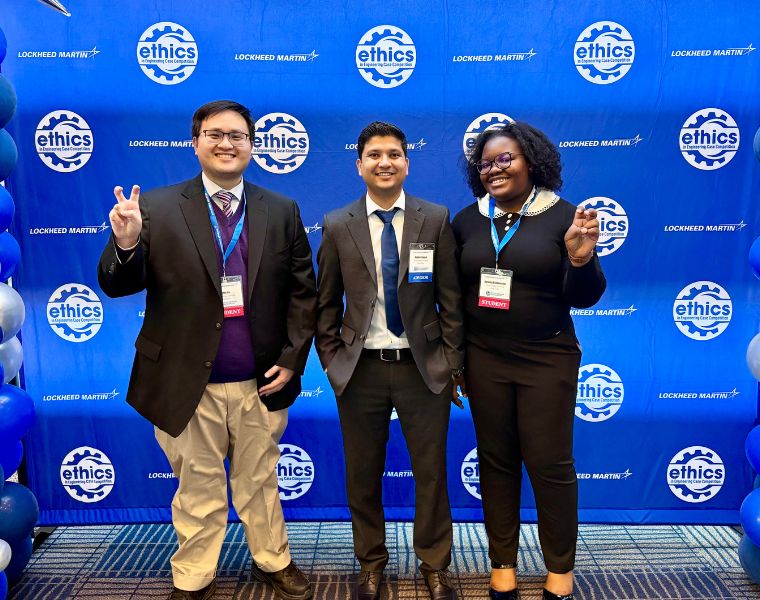
Texas Christian University made its first appearance at the 2026 Lockheed Martin Ethics in Engineering Competition, giving two computer science students the opportunity to confront difficult questions at the intersection of artificial intelligence, cybersecurity and national security.
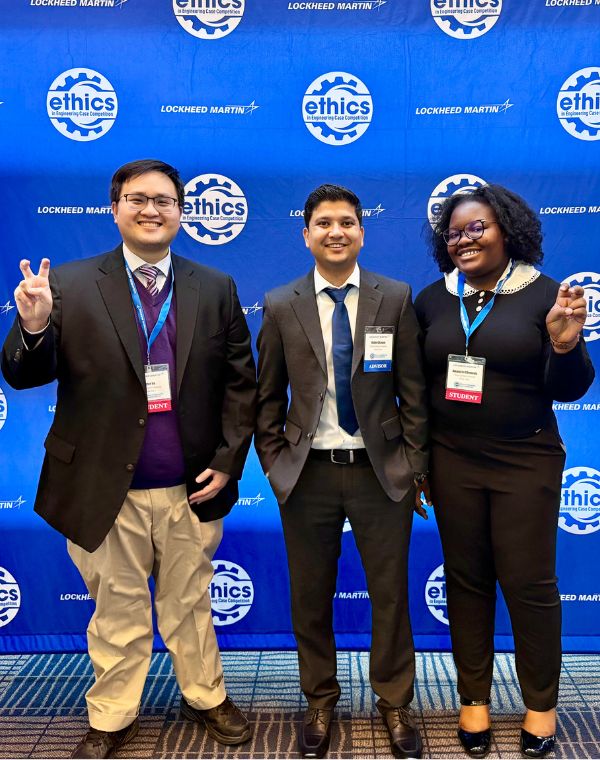
Robin Chataut, assistant professor of computer science and director of graduate studies in the Davis College of Science & Engineering, accompanied senior Peter Vo and junior Amarachi Chiemela to Lockheed Martin’s corporate headquarters in Bethesda, Maryland, for the global event. The competition brought together university teams to examine the kinds of ethical decisions engineers and technology leaders may face in real-world settings.
A central challenge was a rigorous “Black Hat” meeting simulation. Teams were asked to analyze complex AI and security dilemmas from the perspectives of multiple stakeholders, including organizations, government agencies, technical experts and the public. Participants had to weigh competing priorities while defending recommendations that were technically sound, responsible and practical.
Chataut said Vo and Chiemela represented TCU with confidence, intellectual rigor and integrity throughout the event. He was especially proud of the professionalism and depth they demonstrated while working through challenges without simple or obvious answers.
“We learned firsthand how complex AI governance and national security decisions are in practice and how critical ethical leadership is in engineering,” Chataut said.
The Future of AI
The Lockheed Martin competition is part of a broader effort at TCU to prepare students for a rapidly changing technology landscape. Interest in cybersecurity continues to grow among students, particularly as generative AI tools introduce new capabilities, as well as new security risks. Faculty and students are exploring an increasingly important question: How can organizations leverage powerful AI systems while protecting users, sensitive data and critical infrastructure?
Related opportunities have also given TCU students the chance to present their AI and cybersecurity research on international and national stages. Junior Jayapradeep Jayaraman Srinivas traveled with Chataut to Singapore to attend the 2026 AAAI Conference, where they presented research on an AI-driven adaptive tutoring system that uses a multi-agent architecture, retrieval-augmented generation and multimedia learning technologies. Srinivas is the lead author of the work, with Chataut serving as a co-author.
In July, senior Gabby Campos traveled to Arlington, Virginia, to present their research, “Where LLM-Assisted Cyberattacks Break Down: A Stage-Level Analysis of Workflow Execution Boundaries,” at DBSec 2026. The research examined the capabilities and limitations of large language models in carrying out cyberattack workflows, including where human intervention and existing security tools remain necessary.
The growing interest has also contributed to strong internship outcomes, allowing students to apply cybersecurity and AI skills in professional environments. These experiences connect classroom learning with the technical, ethical and organizational demands students will encounter in the workplace.
TCU is also recruiting students for its computer science doctoral program. Prospective Ph.D. students interested in cybersecurity, trustworthy AI, large language model security and related research areas are encouraged to explore the program.
For Chataut, the goal extends beyond teaching students how emerging technologies work. It is about developing ethical security leaders who can make responsible decisions in the age of AI.