Horned Frogs in the High Arctic
TCU faculty and doctoral students research connections among Arctic ponds, insects, spiders, birds and foxes in northwestern Greenland.
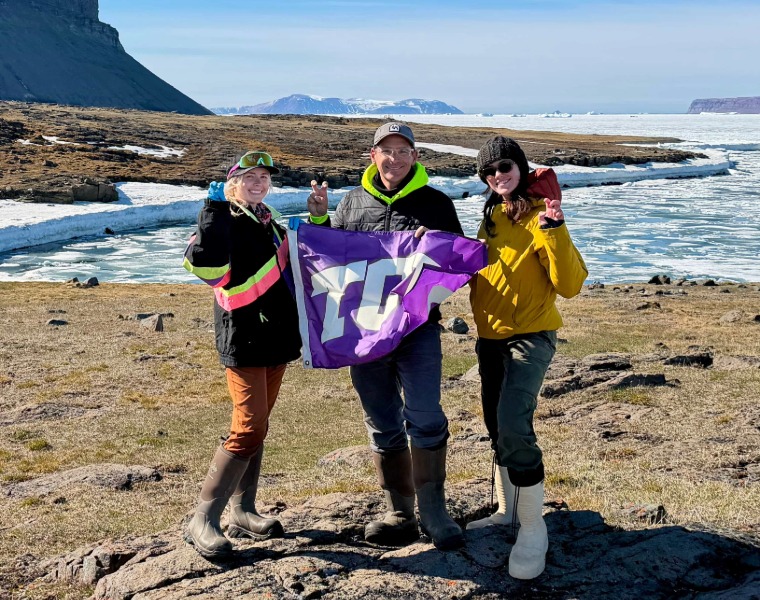
Under a sun that never set, a TCU team from the Aquatic Ecology lab in the Louise Dilworth Davis College of Science & Engineering spent six weeks at the Pituffik Space Base in Northwestern Greenland, studying Arctic ponds and the animals around them. Working alongside colleagues from the High Arctic Institute and Texas State University, the team examined everything from emerging insects and wolf spiders to nesting birds and Arctic foxes.
The Horned Frog team included Matt Chumchal, professor of biology and director of the Pre-Health Professions Institute, and TCU doctoral students Nicole Fordree and Cami Middlebrooks. Their project was funded by the American Scandinavian Foundation, American Philosophical Society Lewis and Clark Fund for Exploration and Field Research, TCU Research and Creative Activities Fund Grant, Davis College of Science and Engineering SERC Grant, TCU Department of Biology, TCU Office of Graduate Studies Travel Grant and the Fort Worth Audubon Society. Follow their field journal from the first equipment deployment to the final wildlife surveys.
Week 1: Getting Started
After unpacking our field gear and assembling sampling equipment, we got straight to work. Our first priority was to deploy aquatic and terrestrial insect traps and temperature loggers across 20 ponds and collect the first water chemistry samples. In five days, we deployed over 1,224 passive insect samplers and collected water samples from ponds. Together, these samples will help us understand pond food webs and how contaminants, like mercury, move through them.
While there, we celebrated Greenland Day with American, Danish and Greenlandic community members who treated us to a traditional Greenlandic meal. The Base is staffed by American service members, but operations are supported by American, Danish and, of course, Greenlandic contractors. The base has a secondary science mission, so you often see colleagues from NASA, NSF and universities from around the world. One of our favorite parts of working here is getting to interact with people from all over the world!
We ended the week with all traps in place and turned to the next part of the project: collecting insects and monitoring birds.
Week 2: Sample Collecting
Summer was just beginning to dawn in the High Arctic, bringing bursts of color across the landscape. Tiny Arctic wildflowers dotted the tundra around us, bringing life back to the landscape after a long, harsh winter. This week, we began collecting insect samples from the passive traps and banding snow buntings and Lapland longspurs. Insects were emerging in earnest from low-elevation ponds. Near the Greenland Ice Sheet, however, emergence was just beginning from ponds that had been covered in ice just a week or two before. Every bird we collected and banded in late June had brood patches, indicating that they were preparing to nest.
Week 3: Getting Foxy
This week, we set out scent stations equipped with camera traps and “scratching pads” to collect images and hair from Arctic foxes. Each visit a fox makes could leave behind a photograph and a few hairs. The hair will help us learn more about diet and mercury exposure of Arctic foxes living in the Pituffik region of northwestern Greenland. One of our more memorable participants at our rub stations was an Arctic fox we affectionately called “Snaggletooth Stu.” His distinctive snaggletooth made him easy to recognize, and his repeat visits quickly made him a field favorite.
This week we took our first day off and enjoyed a polar plunge in the Arctic Ocean, a Danish Queen cover band and a traditional summer barbecue. Our Danish friends at the recreation center know how to throw a great party!
Week 4: Spiders Make Great Researchers
Spiders can tell us a great deal about the environment around them. This week we focused on collecting wolf spiders from around the Pituffik region using pitfall traps and even collecting by hand. These predators are found across the tundra and, collectively, can have far more biomass than charismatic mammals, like polar bears. Because spiders can serve as sentinels of contamination from nearby aquatic systems, the spiders we collected will help us examine how the chemistry and biological processes of Arctic ponds influence contaminant levels in land-dwelling predators.
Speaking of polar bears, we had a bit of excitement when a mother bear and her cubs crossed the base, putting us into lockdown until the bear family had made their way across the valley. Greenlandic partners that work on the base tracked the bears while they were in the area and gave an all-clear when they had traveled a safe distance away.
Week 5: Mosquitoes Have a Purpose, Too
This week, we turned our attention to collecting emerging aquatic insects throughout the Pituffik region. Midges begin life in water, then emerge as adults and move onto the tundra. In doing so, they carry essential energy and nutrients to spiders and birds, but they can also carry aquatic contaminants. Using sweep nets and floating traps, we collected insects to better understand both sides of the ecological connection.
This week’s excitement included some vehicle maintenance. We do some repairs and maintenance ourselves, but luckily the base is equipped with a full-service auto shop and Danish mechanics who can expertly repair our field vehicles when things go really wrong.
Week 6: That’s a Wrap
In our final week, we began retrieving insect emergence traps and sensors from more than 20 water bodies in and around Pituffik Space Base. The data will provide a foundation for understanding how aquatic insects move energy, nutrients and contaminants into the surrounding tundra food web. The team, in cooperation with the High Arctic Institute, also conducted peregrine falcon surveys at several locations around the peninsula. One highlight of the surveys was finding peregrine falcons nesting on the cliffs around base after a three-year absence. The discovery capped six weeks of fieldwork in the High Arctic.

Epilogue: The Journey Home
The adventure did not end when we left Greenland. With more than 100 pounds of frozen samples packed for transport, the clock was ticking: We had to get our precious cargo safely back to the lab at TCU before it thawed. We checked in at 6 a.m. for a five-hour flight operated under a military contract to Baltimore. When our connecting flight was delayed, we loaded the samples into an Uber and headed to Washington, D.C., to catch another flight to DFW. We finally arrived home around 10 p.m. and delivered every sample safely to the lab.
In many ways, arriving home marked the beginning of the real work. With the help of a team of undergraduate research assistants, we will spend the next year processing and analyzing the samples. Cami and Nicole will use the resulting data in their doctoral dissertations. Ultimately, this work will deepen our understanding of Greenland’s unique ecosystems and the threats they face from environmental contaminants.